How Does Lungora Work? A Look at Each Ingredient
Lungora relies on six blend ingredients, each studied for its own role in the body.
Research looks at magnesium for sleep, alpha lipoic acid for blood sugar, butcher's broom for veins, L-carnitine for metabolism, turmeric for inflammation and CoQ10 for heart function.
Next, see how to take one capsule a day.
What this page means by "how it works"
“How it works” usually implies a mechanism someone tested. For Lungora, the honest version of that question splits into two smaller ones: what does the published research say each of the six blend ingredients actually does, and can an unpublished amount of it, sharing a 575 mg total with five other names, plausibly deliver that?
This page answers both, ingredient by ingredient, and draws one distinction carefully: the difference between magnesium given by IV in a hospital and magnesium swallowed in a capsule at home. They are not the same intervention, and the research behind one says nothing about the other.
The seller's own "how it works" graphic, read literally
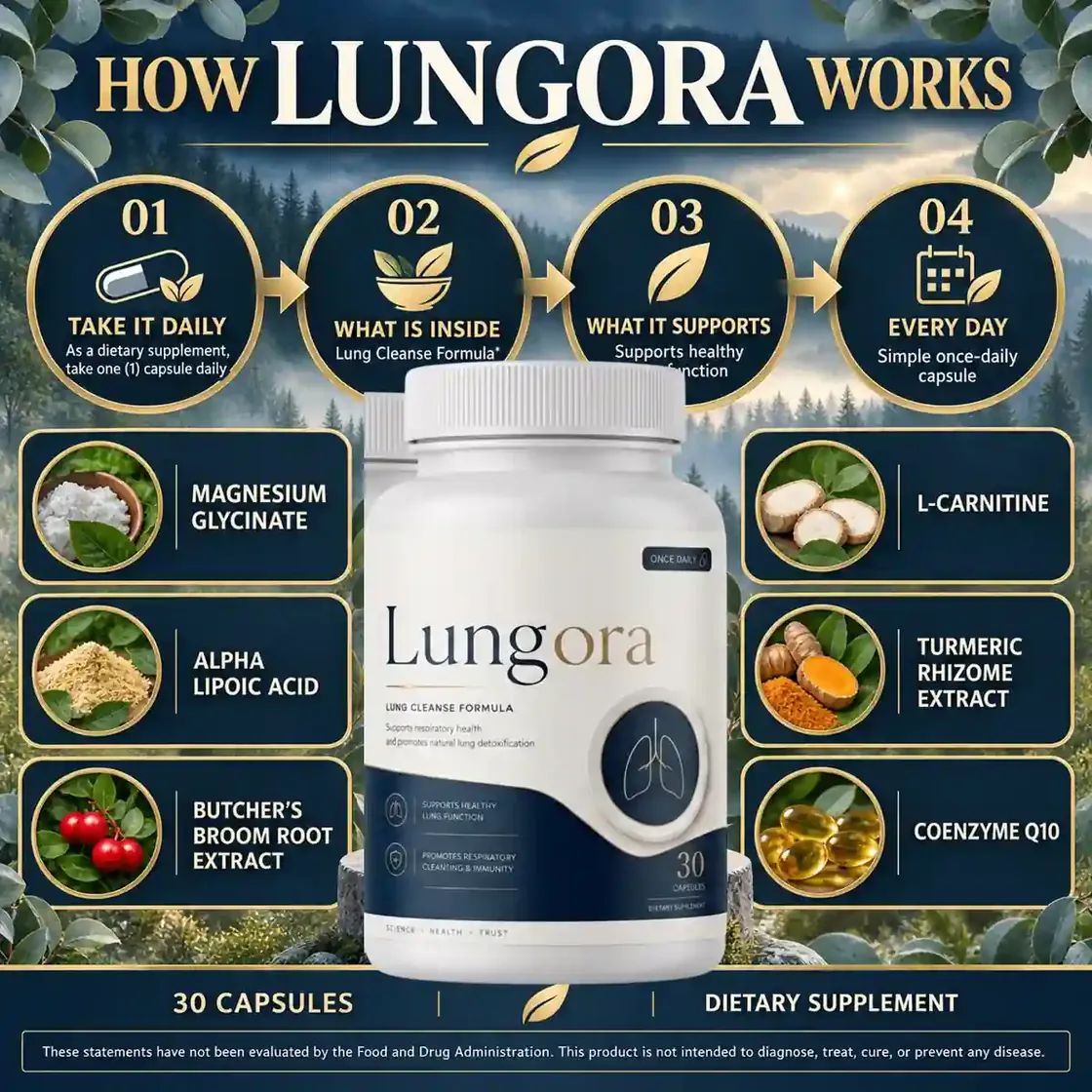
This four-step graphic is seller artwork, not a clinical diagram. Its four circles read “Take It Daily,” “What Is Inside,” “What It Supports” and “Every Day.” Read plainly, that is a description of a habit, not a mechanism: take a capsule, here is what is in it, here is the label's support wording, repeat tomorrow.
The graphic also does one thing well: it names all six blend ingredients next to their own images, magnesium glycinate through Coenzyme Q10. What it does not show, because the label does not give it, is how much of each one that daily capsule actually contains.
Nothing about how it works is demonstrated by an infographic. It is demonstrated, if at all, by the trials behind each named ingredient, which is what the rest of this page walks through.
What each ingredient is studied for, in one line each
| Ingredient | What it is studied for | Representative source |
|---|---|---|
| Magnesium Glycinate | Deficiency correction, sleep and muscle symptoms. | American et al., 2021 |
| Alpha Lipoic Acid | Blood sugar control and nerve comfort in diabetes. | Jibril et al., 2022 |
| Butcher's Broom Root Extract | Chronic venous insufficiency and leg swelling. | Vanscheidt et al., 2002 |
| L-Carnitine | Exercise metabolism and fatty-acid transport. | Sawicka et al., 2020 |
| Turmeric Extract 95% Curcuminoids | Joint inflammation and osteoarthritis pain. | Wu et al., 2019 |
| Coenzyme Q10 | Heart failure and mitochondrial support. | Xu et al., 2024 |
Read down that middle column and a pattern shows up fast: veins, nerves, blood sugar, muscles, joints and mitochondria. No respiratory or airway endpoint appears anywhere in it, because none of the trials behind these six names tested one.
Magnesium: the one ingredient with any respiratory link at all
What magnesium is studied for, by mouth
Oral magnesium is studied for correcting low magnesium, easing muscle cramps and supporting sleep. National Institutes of Health, 2026 reviews magnesium’s effects on blood pressure, heart disease, diabetes and bone health. Asthma or airway function is not mentioned anywhere in that review.
Where IV magnesium actually helps
American et al., 2021 summarizes a Cochrane review: intravenous magnesium sulfate, given as a 1.2 to 2 gram infusion in an emergency department during a severe asthma attack, cut hospital admissions in children and, more modestly, in adults. That is the entire respiratory magnesium story.
An emergency IV infusion is a different route, a different dose by roughly an order of magnitude, a different clinical setting and a different patient state than an 80 mg oral capsule taken daily at home. The Cochrane evidence is real, and it is not evidence for this product. There is no oral magnesium glycinate trial for asthma or any airway outcome to point to instead.
The other five, each in their own studied territory
Alpha lipoic acid
Studied mainly in type 2 diabetes. Jibril et al., 2022 found small glycemic improvements across 200 to 1,200 mg a day. It also lowers blood sugar in people without diabetes, which is a safety point as much as an effect.
Butcher's broom
Vanscheidt et al., 2002 tested a standardized extract against placebo in chronic venous insufficiency and measured real reductions in leg volume and swelling. No human respiratory trial of it was found anywhere.
L-carnitine
Sawicka et al., 2020 reviewed exercise and metabolic trials at 1 to 4 grams a day. It moves fatty acids into mitochondria for energy production, a cellular process with no airway component.
Turmeric extract
Wu et al., 2019 pooled trials of curcumin for knee osteoarthritis at 500 to 1,000 mg a day. Its studied territory is joints and inflammation markers, not lungs.
Coenzyme Q10
Xu et al., 2024 pooled 32 heart-failure trials at 30 to 400 mg a day and found reduced mortality and hospitalization. That is a cardiac finding in diagnosed heart failure, not a general respiratory one.
What an unpublished amount inside 575 mg can and cannot support
Here is what a 575 mg blend can support, and what it cannot. It can plausibly carry a modest amount of several ingredients at once, which is exactly what a multi-ingredient blend is designed to do. What it cannot do is carry six ingredients at their own individually studied doses simultaneously: alpha lipoic acid alone is commonly studied around 600 mg a day, L-carnitine at 1 to 3 grams, curcumin at 500 to 1,000 mg and CoQ10 at 100 to 300 mg. Each of those, on its own, is at or above the entire 575 mg blend.
That is not proof any one ingredient is present at a useless trace amount. It is proof that the label does not give a reader enough information to rule that out, either. An unpublished amount inside a combined total can support a plausible story. It cannot support a checkable one.
Full arithmetic on the magnesium line specifically is on what elemental magnesium means. What each ingredient amounts to on the panel is on the ingredients page.
Positive-trial doses, set next to the whole blend
| Ingredient | Dose used in the positive research | Whole 575 mg blend |
|---|---|---|
| Alpha lipoic acid | About 600 mg a day for the strongest glycemic effect | Smaller than this dose alone |
| L-carnitine | 1,000 to 4,000 mg a day across trials | Smaller than the low end of this range |
| Turmeric (curcuminoids) | 500 to 1,000 mg a day | Smaller than this dose alone |
| Coenzyme Q10 | 100 to 400 mg a day, most often 100 to 300 mg | Smaller than the low end of this range |
| Butcher's broom extract | Roughly 1,000 mg three times a day in venous trials | Smaller than a single one of those three doses |
This table is not an accusation that the blend contains none of any ingredient. It is a scale check: a 575 mg total cannot hold five ingredients at their own individually effective doses at the same time, so at least some of them are necessarily present at a fraction of what their own positive trials used. Which ones, and by how much, is exactly what the label does not say.
Every citation on this page is about an isolated ingredient, tested on its own at a stated dose, for a stated condition. None of them tested Lungora. No published clinical trial of this specific capsule, at whatever amounts it actually contains, was found anywhere. Anything this page says about the six ingredients is about the ingredients in general, not a demonstrated result for this bottle.
When the answer is a doctor, not an ingredient list
- Shortness of breath that is new or getting worse
- A cough that has run past three weeks
- Coughing up blood
- Wheezing
- Chest pain
Any of those is a reason to call a doctor, not a reason to look for a better-dosed supplement. None of the six ingredients here, at any amount, is a substitute for that appointment. More on interactions and warning signs sits on the side effects page.
How It Works: common questions
Does Lungora work the way the bottle describes?
The bottle describes a habit, not a mechanism. Each of the six blend ingredients has real research behind it, but none of that research is about lungs, and no trial of this product exists.
What is magnesium actually studied for?
Correcting low magnesium, muscle cramps and sleep by mouth. Its only respiratory link is intravenous magnesium for severe asthma attacks in a hospital, which is a different route and dose than an oral capsule.
Can an oral magnesium capsule help an asthma attack the way an IV does?
No. The IV evidence is for a 1.2 to 2 gram infusion given in an emergency department. An 80 mg oral capsule taken daily is a different intervention entirely, with no trial supporting the same use.
Is butcher's broom studied for breathing?
No. It is studied for chronic venous insufficiency and leg swelling. No human respiratory trial of it was found.
Why does the amount inside the blend matter for how it works?
Several of these ingredients are commonly studied at doses equal to or larger than the entire 575 mg blend. An undisclosed amount cannot be matched against those studies.
Has Lungora itself been tested in a clinical trial?
No published trial of this specific product was found. The citations on this site are about individual ingredients studied on their own, not about this capsule.
What should I do if my breathing has actually changed?
See a doctor, especially for shortness of breath, a cough past three weeks, coughing blood, wheezing or chest pain. No supplement on this page substitutes for that evaluation.
Keep reading
What is actually inside the 575 mg blend?
The six ingredients in label order, their studied doses, and what each one is.
Read →What interactions should I check before taking this?
Magnesium's upper limit, CoQ10 and warfarin, alpha lipoic acid and blood sugar, and red flags for a doctor.
Read →What is Lungora actually allowed to claim?
Every bottle and sales-page claim, what it legally is, and what evidence backs it.
Read →Order Lungora from the authorized retailer
30 capsules per bottle, one capsule a day. Kits of 2, 3 or 6 bottles run from $49 a bottle on the sales page, with a 60-day money-back guarantee. Questions first? The FAQ page answers most of them.