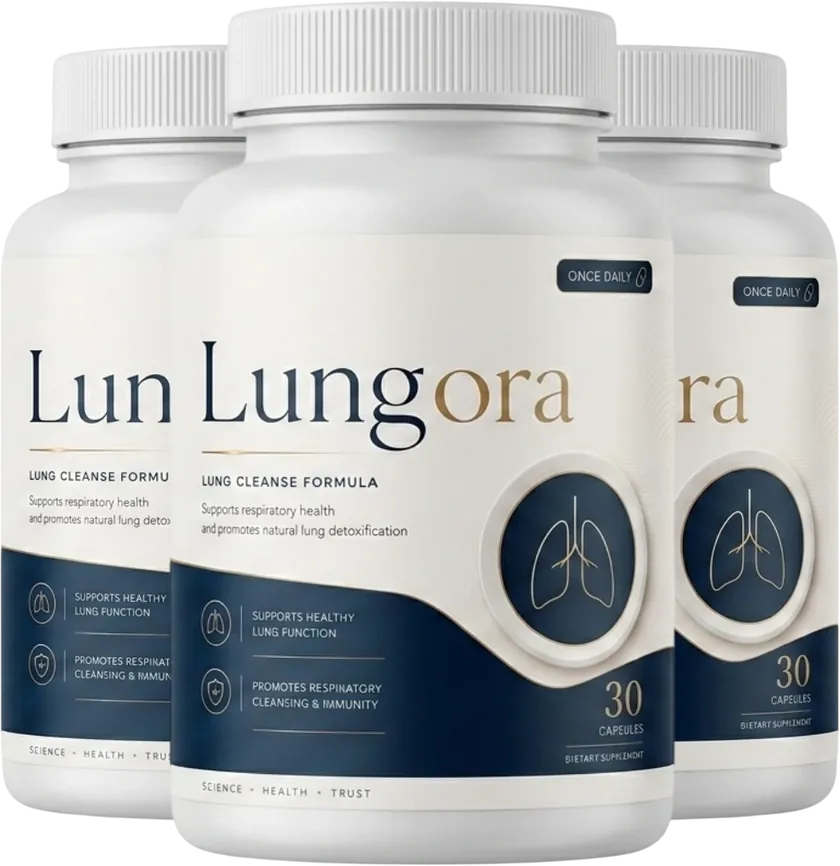
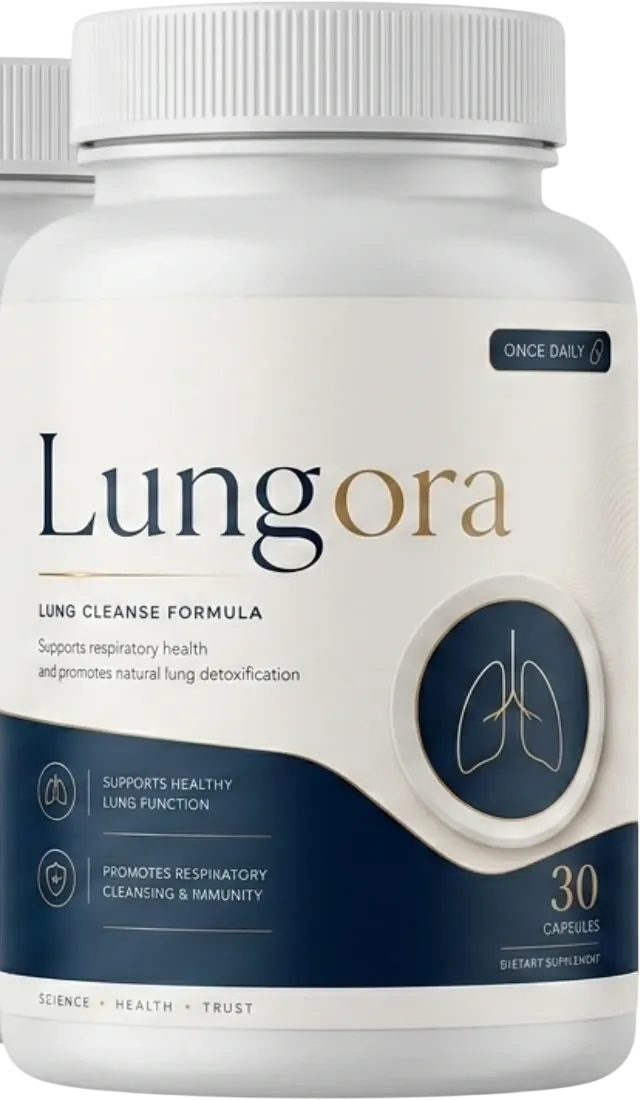
Lungora Ingredients: What Is Inside Each Capsule
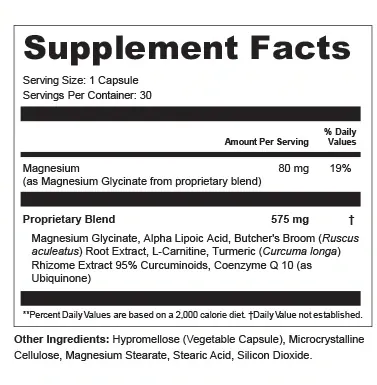
Each Lungora capsule gives 80 mg of magnesium and a 575 mg blend of six ingredients.
The blend holds magnesium glycinate, alpha lipoic acid, butcher's broom, L-carnitine, turmeric and CoQ10. Magnesium is the one with its own printed amount, 19% of the Daily Value.
To read every line of the label, see the full supplement facts panel.
One measured line, and a blend that hides the rest
Turn the bottle around and the Supplement Facts panel gives you exactly two numbers. One capsule a day, and 80 mg of magnesium. Everything else the bottle is sold on, the alpha lipoic acid, the butcher’s broom, the L-carnitine, the turmeric, the CoQ10, sits inside a single 575 mg line called Proprietary Blend.
That is legal. US labeling rules let a maker total a blend instead of breaking out each piece. It also means a reader cannot check any of those six against a study dose, because a study dose is a number and this label gives none.
The full panel, laid out as a table
| Ingredient | Amount | What it is |
|---|---|---|
| Magnesium (as Magnesium Glycinate from proprietary blend) | 80 mg · 19% DV | Chelated mineral, measured |
| Proprietary Blend | 575 mg † | Six ingredients, combined weight only |
| Inside the 575 mg blend (label order) | Category |
|---|---|
| Magnesium Glycinate | chelated mineral |
| Alpha Lipoic Acid | fatty acid |
| Butcher's Broom Root Extract | Ruscus aculeatus |
| L-Carnitine | amino acid derivative |
| Turmeric Rhizome Extract 95% Curcuminoids | Curcuma longa |
| Coenzyme Q10 (as Ubiquinone) | quinone |
Other ingredients: Hypromellose (Vegetable Capsule), Microcrystalline Cellulose, Magnesium Stearate, Stearic Acid, Silicon Dioxide. None of those five are active for anything; they hold the capsule together and keep the powder flowing while it is filled.
Why the label order actually tells you something
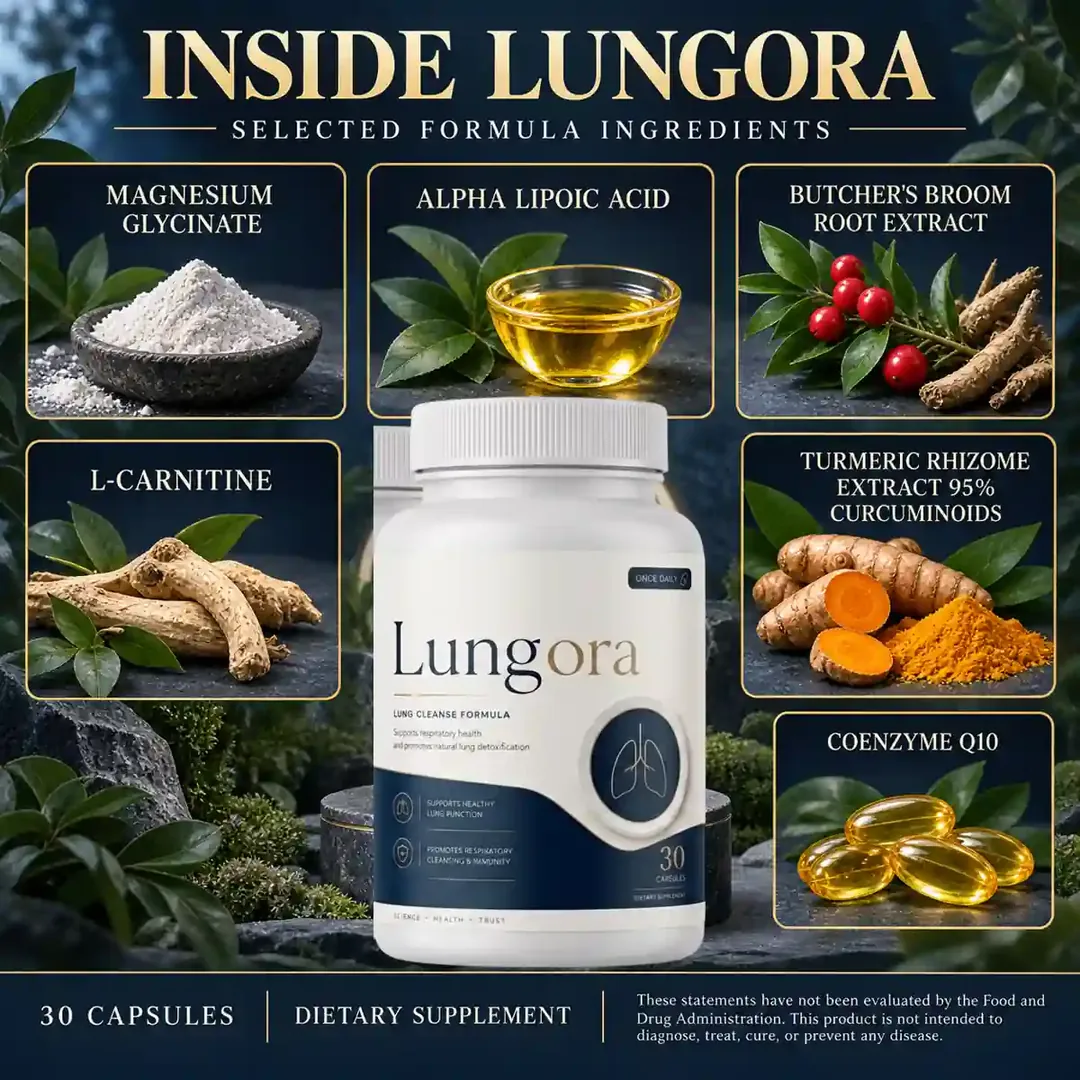
US supplement rules require a proprietary blend to list its contents heaviest to lightest by weight. That single rule is the only ordering information this label gives you, and it is worth reading literally.
Magnesium glycinate leads the blend, which lines up with it also being the one ingredient measured above the blend line. Coenzyme Q10 closes the list, which means whatever milligram figure it carries is the smallest of the six.
This artwork is seller artwork, not an independent measurement. It does name all six ingredients clearly, which is more than a lot of these panels manage, but it adds no amounts beyond what the label already gives.
The gap between first and last matters because of the arithmetic on what elemental magnesium means: if magnesium glycinate needs most of the 575 mg to deliver 80 mg of elemental magnesium, the other five, including the CoQ10 at the back of the line, are competing for whatever is left.
Each ingredient, its studied dose, and its safety note
Magnesium (as Magnesium Glycinate)
magnesium bisglycinate · chelated mineral
The only measured line on the panel, and the only one whose weight can be worked out. This is the one ingredient on the label with a disclosed number: 80 mg of elemental magnesium (19% DV), described as coming 'from proprietary blend' as magnesium glycinate.
- In one serving
- 80 mg of elemental magnesium (19% of the Daily Value), drawn from the blend
- Dose used in research
- NIH ODS sets the adult RDA at 310-420 mg/day
- Safety note
- This product's 80 mg/day of elemental magnesium is well under the 350 mg/day supplemental Upper Limit NIH ODS sets, so magnesium toxicity is not a realistic concern at the labeled dose.
Alpha Lipoic Acid
alpha lipoic acid · fatty acid
An antioxidant usually studied at 600 mg a day, which is more than this whole blend. ALA's exact amount in this product is undisclosed inside the 575 mg proprietary blend, which as a whole is smaller than several single studied ALA doses (600-1,200 mg) on its own.
- In one serving
- Inside the 575 mg blend (amount not published)
- Dose used in research
- Human trials of oral alpha lipoic acid have used 200-1,200 mg/day
- Safety note
- Alpha lipoic acid can lower blood sugar and, in rare documented cases, trigger insulin autoimmune syndrome with severe, sometimes prolonged hypoglycemia.
- Sources
- Jibril et al., 2022
Butcher's Broom Root Extract
Ruscus aculeatus · root
A well-studied vein herb. We found no human trial of it for any lung or breathing outcome. The evidence behind butcher's broom is real but entirely about veins, not lungs: it is a well-studied treatment for chronic venous insufficiency and related leg symptoms/edema, rated among the better-supported venous herbs in independent evidence reviews.
- In one serving
- Inside the 575 mg blend (amount not published)
- Dose used in research
- Clinical trials and evidence-graded reviews use standardized Ruscus aculeatus extract at roughly 15-30 mg ruscogenins three times daily, or about 1,000 mg encapsulated extract three times daily
- Safety note
- No major safety signal emerged in the venous-insufficiency trials reviewed, which generally reported good tolerability.
L-Carnitine
L-carnitine · amino acid derivative
Trials usually run at one to three grams a day, several times this entire blend. L-carnitine's amount here is undisclosed within the 575 mg blend -- itself well below even the low end (1,000 mg) of typically studied daily doses, let alone the higher end (up to 4,000 mg/day).
- In one serving
- Inside the 575 mg blend (amount not published)
- Dose used in research
- Human trials most commonly use 1-4 g/day
- Safety note
- NIH ODS reports doses around 3 g/day can cause nausea, vomiting, cramps, diarrhea, and a fishy body odor.
Turmeric Extract 95% Curcuminoids
Curcuma longa · rhizome
Standardised to 95% curcuminoids, with no piperine or delivery system named on the label. The label specifies the turmeric extract is standardized to 95% curcuminoids but discloses no milligram amount and no piperine or other bioavailability-enhancing technology, inside a 575 mg blend that is itself below the 500-1,000 mg/day curcumin doses used in positive trials -- meaning both the amount and the absorbability of this product's turmeric are uncertain.
- In one serving
- Inside the 575 mg blend (amount not published)
- Dose used in research
- Clinical trials of curcumin/turmeric extract most commonly use 500-1,000 mg/day of curcumin or curcuminoids, and plain oral curcumin has very poor bioavailability without an absorption enhancer such as piperine
- Safety note
- Plain turmeric is described by NCCIH as likely safe short-term at typical amounts, but both NCCIH and LiverTox document a real, idiosyncratic, sometimes severe liver-injury risk associated with turmeric/curcumin supplements -- disproportionately with high-bioavailability formulations -- presenting as fatigue, nausea, poor appetite, dark urine, or jaundice.
Coenzyme Q10 (as Ubiquinone)
ubiquinone · quinone
Last in the blend, so the smallest share. Trials usually use 100 to 300 mg a day. CoQ10's amount is undisclosed within the 575 mg blend, which on its own is below the low end (100 mg/day) of typically effective studied doses once the other five ingredients are accounted for.
- In one serving
- Inside the 575 mg blend (amount not published)
- Dose used in research
- Cardiac and general-health trials of CoQ10 most commonly use 100-300 mg/day
- Safety note
- CoQ10 is generally well tolerated at the 100-400 mg/day doses studied, with no major toxicity signal in the reviewed sources.
- Sources
- Raizner et al., 2019 · Xu et al., 2024
Tap through all six. The evidence bars show human research volume, not a Lungora-specific result, because no trial of this product has been run.
What each name is studied for, versus what the bottle is named after
| On the label | What the research is actually about | Human lung evidence |
|---|---|---|
| Magnesium Glycinate | An essential mineral. Deficiency correction, sleep and muscle symptoms. Intravenous magnesium has a role in severe asthma attacks in hospital. | Only by drip, in hospital |
| Alpha Lipoic Acid | An antioxidant studied mainly for blood sugar, nerve comfort and weight. | None found |
| Butcher's Broom Root Extract | A vein herb. The real evidence is in chronic venous insufficiency and leg swelling. | None found |
| L-Carnitine | Moves fatty acids into mitochondria. Studied for exercise, heart and metabolic outcomes. | None found |
| Turmeric Extract 95% Curcuminoids | An anti-inflammatory plant extract studied across joints, metabolism and inflammation markers. | None found |
| Coenzyme Q10 | A mitochondrial cofactor studied for heart failure, statin muscle symptoms and migraine. | None found |
None of this means the six ingredients are worthless. Magnesium, turmeric, CoQ10, alpha lipoic acid, L-carnitine and butcher’s broom all have real literature behind them. It means that literature is about veins, nerves, blood sugar, muscles and mitochondria, and that a bottle called a lung cleanse formula does not contain a single ingredient chosen for lungs.
Magnesium is the near miss
Intravenous magnesium has a real role in severe asthma attacks, given as a drip in an emergency department. That is a different route, dose and setting from an oral capsule taken at home.
Butcher's broom is a vein herb
Its trial record is in chronic venous insufficiency and leg swelling. We found no human trial of it for breathing, coughing or any airway outcome.
The other four are metabolic, not respiratory
L-carnitine, turmeric, CoQ10 and alpha lipoic acid are studied for exercise, joints, hearts and blood sugar. None of that research touches lungs.
What research doses look like next to a 575 mg total
| Ingredient | Typical studied dose | This blend |
|---|---|---|
| Alpha lipoic acid | About 600 mg a day in diabetes trials | Undisclosed, inside a 575 mg total |
| L-carnitine | 1 to 3 grams a day | Undisclosed, inside a 575 mg total |
| Turmeric (curcuminoids) | 500 to 1,000 mg a day | Undisclosed, inside a 575 mg total |
| Coenzyme Q10 | 100 to 300 mg a day | Undisclosed, inside a 575 mg total |
| Butcher's broom extract | Roughly 1,000 mg three times a day in venous trials | Undisclosed, inside a 575 mg total |
| Magnesium (elemental) | 80 mg printed on this label | The only figure that is disclosed |
Look at the first row alone: Jibril et al., 2022 used 200 to 1,200 mg a day of alpha lipoic acid, and the smallest dose that moved fasting glucose in that review was 600 mg. That number by itself is bigger than the entire 575 mg blend, before turmeric, CoQ10, L-carnitine, butcher’s broom or the rest of the magnesium take their share.
None of the six ingredients is fake or worthless. Real literature backs magnesium, alpha lipoic acid, butcher's broom, L-carnitine, turmeric and CoQ10, in their own studied contexts. The issue is narrower: nothing on this panel was chosen for lungs, and no amount is published for five of the six, which makes the blend impossible to weigh against any of the research above.
When the question is bigger than an ingredient list
None of this is a reason to self-diagnose from a supplement label. If breathing has changed, if a cough has run past three weeks, if there is blood in it, wheezing, or chest pain, that calls for a doctor, not a closer read of a proprietary blend.
- Shortness of breath that is new or getting worse
- A cough that has lasted more than three weeks
- Coughing up blood
- Wheezing
- Chest pain
More on how each ingredient interacts with medicines sits on the side effects page. What the panel actually claims is unpacked on the benefits page.
Ingredients: common questions
How many ingredients are in Lungora?
Seven lines on the panel in total: magnesium measured on its own at 80 mg, plus six more names sharing one 575 mg proprietary blend.
Why doesn't the label give an amount for each ingredient?
US rules allow a 'proprietary blend' to list a combined weight instead of individual amounts. Lungora uses that allowance for everything except magnesium.
What order are the blend ingredients listed in?
Heaviest to lightest by weight, which is a labeling requirement. Magnesium glycinate leads; Coenzyme Q10 is last, so it is the smallest amount of the six.
Is any ingredient in Lungora actually for lungs or breathing?
No. Magnesium's only respiratory link is intravenous magnesium for severe asthma attacks in hospital, not an oral capsule. Butcher's broom is a vein herb. The rest are metabolic.
Is butcher's broom good for breathing?
Its real evidence is in chronic venous insufficiency and leg swelling. No human trial for a lung or breathing outcome was found.
Does the 575 mg blend match typical research doses?
Not once you add them up. Alpha lipoic acid trials alone commonly use 600 mg a day, more than the entire blend, before the other four ingredients and the magnesium take their share.
Is the seller artwork naming the ingredients reliable?
It correctly names all six blend ingredients, which is unusual and worth crediting. It adds no milligram amounts beyond what the label already states.
Keep reading
How do I read the whole Supplement Facts panel?
Serving size, the dagger symbol, % Daily Value and the distributor block, explained line by line.
Read →What is each ingredient actually studied for?
What a 575 mg blend can and cannot support, and why intravenous magnesium is not an oral capsule.
Read →What should I check before taking this with a medicine?
Magnesium's upper limit, the CoQ10 and warfarin question, alpha lipoic acid and blood sugar, and the red flags that mean call a doctor.
Read →Order Lungora from the authorized retailer
30 capsules per bottle, one capsule a day. Kits of 2, 3 or 6 bottles run from $49 a bottle on the sales page, with a 60-day money-back guarantee. Questions first? The FAQ page answers most of them.